Services: The System Lifecycle
A suppression system proves its worth not on the day it is installed, but on the day fire strikes and it is ready. Anywhere in Turkey, from survey to recharge, the same team is with you at every stage.
Planning a new system?
From survey to commissioning — the whole process is on us.
Already have a system?
Maintenance, testing, and recharge — no matter who installed it.
01
Survey & Risk Analysis
We inspect your space on site. What we look at:
- Volume and geometry (including suspended ceilings/raised floors)
- Fuel load and fire class
- Human presence and evacuation conditions
- Ventilation/HVAC — risk of gas escaping at discharge
- Existing detection and panel infrastructure
Output: risk assessment + system recommendation.
02
Engineering & Design
★ our area of expertise
A step-by-step engineering process:
- 1 ·Volume and space analysis → net protected volume
- 2 ·Agent selection and design concentration (EN 15004 / ISO 14520)
- 3 ·Hydraulic calculation with VdS-approved software — verifying agent, pipe diameter, discharge time
- 4 ·Isometric piping drawing and nozzle layout
- 5 ·Pressure relief calculation — protecting the structure of the space
- 6 ·Delivery of the approved project package
03
Installation
Secured piping, correct hanging, approved components. The most common mistake we see in the field in Turkey is faulty installation — look at the gallery of bad installations and see the difference.
04
Commissioning
Function tests, detection scenarios, panel integration, and personnel training. The system is handed over with a report.
05
Periodic Maintenance & Hydrostatic Testing
A scheduled inspection program to keep your system ready at all times:
Interval Checks performed Monthly Pressure gauges, mechanical-damage check Semi-annual / annual Agent quantity (weighing), detection-chain test, nozzle check 5–10 years Hose replacement, hydrostatic test Hydrostatic test: periodic pressure-resistance testing of pressurized cylinders (5–10 year cycle) — a legal requirement. Planned together as a natural part of the maintenance program.
06
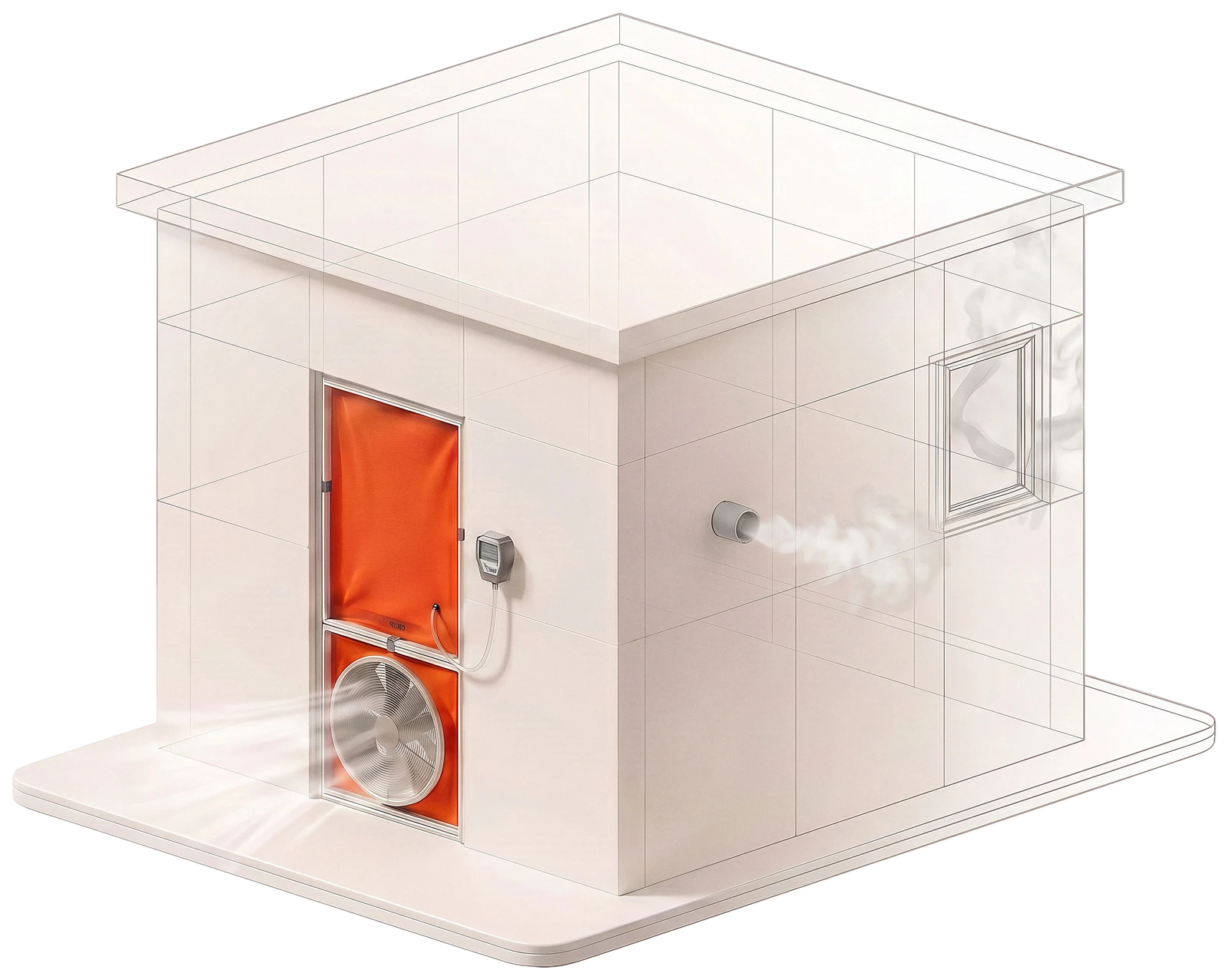
Room Integrity Test (Door-Fan)
★ featured
For a gaseous system to work, 85% of the extinguishing concentration must remain in the space for at least 10 minutes. Using door-fan equipment, we measure the room's leakage area and report it to the standard (EN 15004 / NFPA 2001). Mandatory for new installations; must be repeated if the space is renovated.
07
Recharge & Recommissioning
Agent recharge after discharge, valve overhaul, and recommissioning of the system. On recharge we issue an agent declaration: document what is in your cylinder — few in the industry do this.